William Cooper
A New Perspective
- background and personal history
William Cooper (as seen in source 1)was born in 1960, In Yorta Yorta territory in a small part on the Murray and Goulburn river. He lived with his Mother Kitty and brother Bobby. Coopers long campaign for aboriginal rights began in 1887 when he campaigned for land rights in partition called the Malaga Petition. The Malaga Petition stated that Aborigines of the area, "should be granted sections of land not less than 100 acres per family in fee simple or else at a small nominal rental annually with the option of purchase at such prices as shall be deemed reasonable for them under the circumstances, always bearing in mind that the Aborigines were the former occupiers of the land. Such a provision would enable them to earn their own livelihood..."
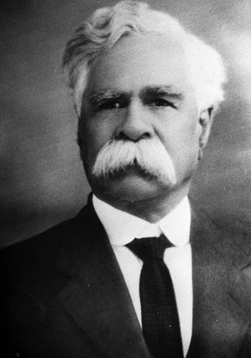
source 1
- role in the struggle for rights and freedoms
William Cooper began his activist future when he was aged in his 70's, his activism stated when he was denied a pension by the government if he stayed in his Aboriginal reserve. Cooper was outraged by this and led to him moving in 1933 to Footscray in western Melbourne. aboriginals in 1933 were classified as apart of the british empire and were not classified as Australian citizens, this is when his second activist role came into place. William Cooper partitioned king George V, (source 2) his campaign received 1814 signatures but unfortunately was not success full. Williams partition also received signatures from some missionaries. William Cooper partitioned governments with Fact-to-Face meetings but they ignored all of his requests. William continuously campaigned for Aboriginal Rights all the way up to the late 1930's. governments kept a close eyes on his activism.

source 2
- short term achievements
In 1935, as secretary of the Australian Aborigines’ Advancement League in Victoria, William Cooper circulates a petition seeking direct representation in parliament and land rights. On the 27th of June 1937, William Cooper campaigned for the education, for full citizenship and parliament representation for all aboriginal people. this campaign is called 'The Progressive Association'. This is seen in source 3.

source 3
- long term achievements
the short term success was his main achievement was the establishment of a 'National Aborigines Day', first celebrated in 1940. On 26 January, as Australia celebrates the 150th anniversary of the landing of the First Fleet in Sydney Cove, Indigenous Australians attend a Day of Mourning and Protest in Sydney. This can be seen in source 4.

source 4
Williams legacy
durring William Coopers life he achieved none of the goals he had set for himself with the exception of the creation of Aborigines Sunday. However after William Cooper death is when the work he did started to pay off. Williams nephew Douglas Nicholls continued his work after his death these partitions were a complete success and ended with the Australian Referendum, 1967.
William Cooper's grandson, Alfred Turner, was presented with a certificate from the Israeli Ambassador On the 6th of December 2008, stating that 70 Australian trees were to be planted in Israel in honor of William Cooper. The ceremony was held at the State Parliament in Melbourne and was attended by members of the Yorta Yorta tribe as well as Victorian Premier John Brumby, Federal Affairs minister Jenny Macklin and jewish leaders.
In December 2010, there were three commemorative events:
- 1. Cooper's great-grandson, Kevin Russell re-enacted the walk from Cooper’s home, meeting up with Cooper’s grandson Uncle Boydie at Federation Square.
- 2. Cooper was honoured in Israel by the creation of an Academic Chair in his honour to support resistance and research of World Holocaust Studies. A professorship attached to this Academic Chair is valued at $1,000,000.
- 3. A Tribute was held at Yad Vashem World Holocaust Memorial, with the family as invited guests. The Australian/Israel Leadership Forum hosted an associated Gala Dinner to be attended by Kevin Rudd, Julie Bishop and another 17 Ministers.
Additionally, the William Cooper Cup is an annual trophy awarded to the winner of an Australian Rules Football match between the Aboriginal All-Stars and Victoria Police at Whitten Oval in Footscray.
